Legacy Launcher errors are easier to fix when you identify the exact project, platform package, and failure stage first. The archived gradenGnostic/LegacyLauncher project is associated with Minecraft Legacy Console Edition, and its latest verified release is v3.5.0 from March 12, 2026. This guide covers failed starts, crashes after a mod or configuration change, installer prompts, missing files, controller or Steam Deck surprises, and mistakes caused by confusing this project with TL Legacy, Legacy4J, or the official Minecraft Launcher. It does not offer cracked builds, game files, account bypasses, or an unverified mirror. Start with the source and version checks below, then follow the platform branch that matches the error you can reproduce.
Source check completed October 8, 2026; use the official release page when a direct asset cannot be verified.
Source check completed October 8, 2026; use the official release page when a direct asset cannot be verified.
verified release facts
Legacy Launcher error checks at a glance
Latest verified release
LegacyLauncher v3.5.0
Published
March 12, 2026
Repository status
Archived and read-only since July 13, 2026
Platforms listed
Windows, macOS, and Linux
Preferred source
Official GitHub release page, not an unknown mirror
why errors happen
Why does Legacy Launcher crash or fail to start?
A startup failure is usually a mismatch between the program you installed and the guide you followed, a package that does not match your operating system, or a local file that changed after the last successful launch. Write down the exact message, the operating system, the package name, and whether the failure happens before the window appears, while a world loads, or after you enable a mod or controller profile. Those details separate a launcher problem from a game-content or environment problem.
The project identity matters because Legacy Launcher is used for several unrelated search intents. Confirm that the repository owner is gradenGnostic, the repository is LegacyLauncher, and the release tag is v3.5.0. TL Legacy, Legacy4J, a Java launcher, and the official Minecraft Launcher have different files and support paths. If the error came from one of those products, copying an LCE fix can make the situation worse. Keep the original message and a backup of the configuration before changing more than one variable at a time.
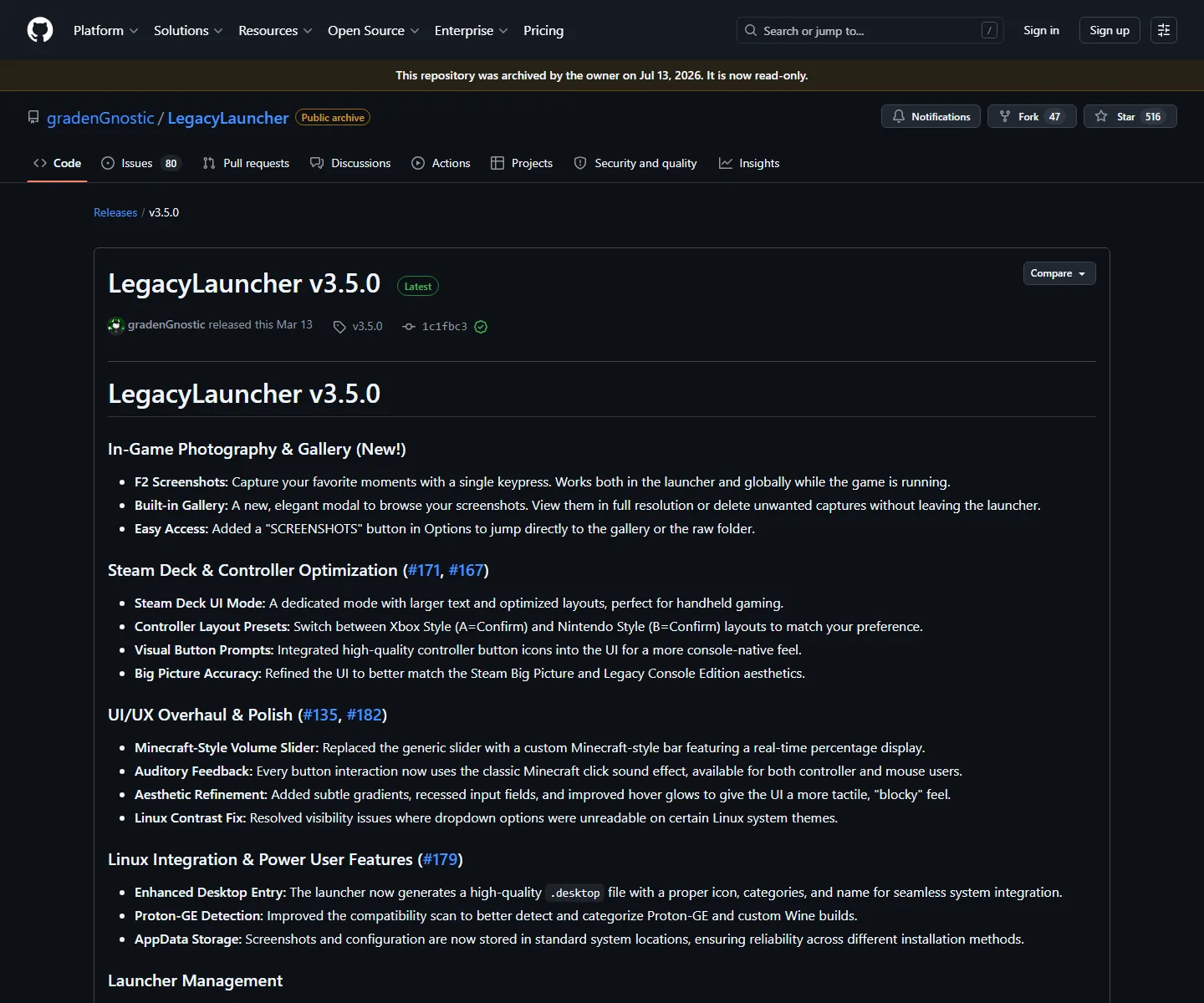
The official release notes connect v3.5.0 to the archived LegacyLauncher repository and describe the final verified feature set.common startup failures
Common startup and crash causes
If the launcher closes immediately, first test a clean start with optional mods, custom arguments, and controller remapping disabled. A mod that crashes on startup, a damaged local profile, or an unsupported Java-oriented instruction can look like a broken launcher. Restore the last known-good configuration, then add changes back one at a time. Do not delete screenshots or saves until you know which folder is involved.
A second common cause is choosing the wrong package. Windows needs the installer build, macOS needs the Intel or Apple Silicon DMG that matches the machine, and Linux needs the AppImage permission and architecture to be correct. A package can download successfully and still fail to run if the CPU architecture, security prompt, or execution permission is wrong. Compare the file name on the official release page before searching for a replacement.
Screenshot workflow: F2 capture, built-in gallery, and a visible SCREENSHOTS path.
Handheld and controller work: Steam Deck mode, Xbox-style and Nintendo-style prompt layouts, and larger UI treatment.
Desktop and Linux polish: contrast fixes, desktop entry support, Proton-GE detection, and standard application-data storage.
Verification boundary: these notes describe v3.5.0; they do not establish a newer release after the repository was archived.
version history
How to read the Legacy Launcher version history
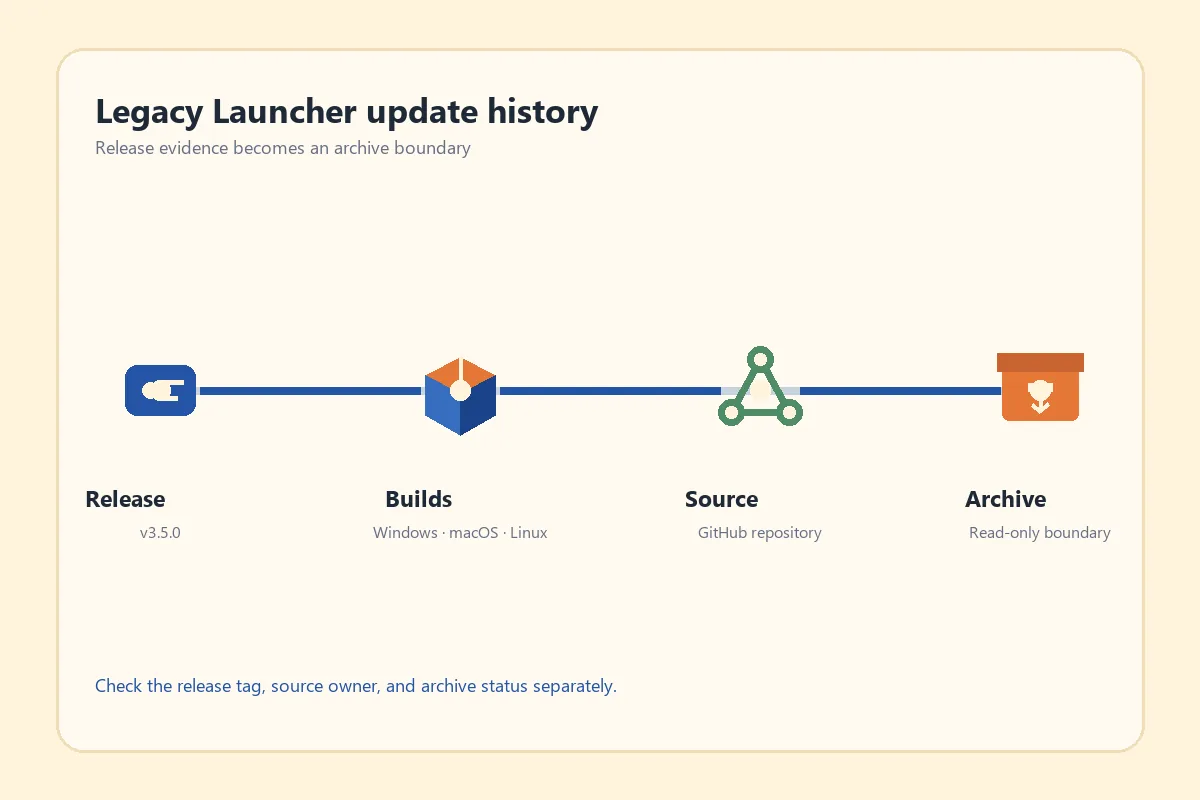
A useful version history has four separate checkpoints. First, identify the repository as gradenGnostic/LegacyLauncher and confirm that its description refers to Minecraft LCE. Second, open the Releases area and locate the v3.5.0 tag rather than relying on a search snippet or a repackaged filename. Third, read the notes for the platform or feature you care about. Fourth, check the archive banner and publication date so that you understand whether the project is still receiving fixes.
This method prevents two common mistakes. The first is mixing a release note from another launcher into the LCE project’s history. The second is reading the word Latest on an old release page as proof that the project is still actively maintained today. In this case, v3.5.0 remains the latest release verified by the source review, while the repository’s archived status means the maintenance expectation is different from an active launcher’s update channel.
Start from the official repository or release page, not from a file-sharing result. Check that the owner is gradenGnostic, that the repository name is LegacyLauncher, and that the release notes describe the LCE launcher you are trying to use. If a page redirects to a different project, stop and compare the product identity before downloading anything.
Finally, use the release page’s own asset list or the site’s verified download guidance. Do not claim that an asset is safe merely because the filename ends in EXE, DMG, or AppImage, and do not treat a third-party mirror as official. If direct asset verification is unavailable, keep the official release page as the destination and inspect the file through your normal operating-system security tools before opening it.
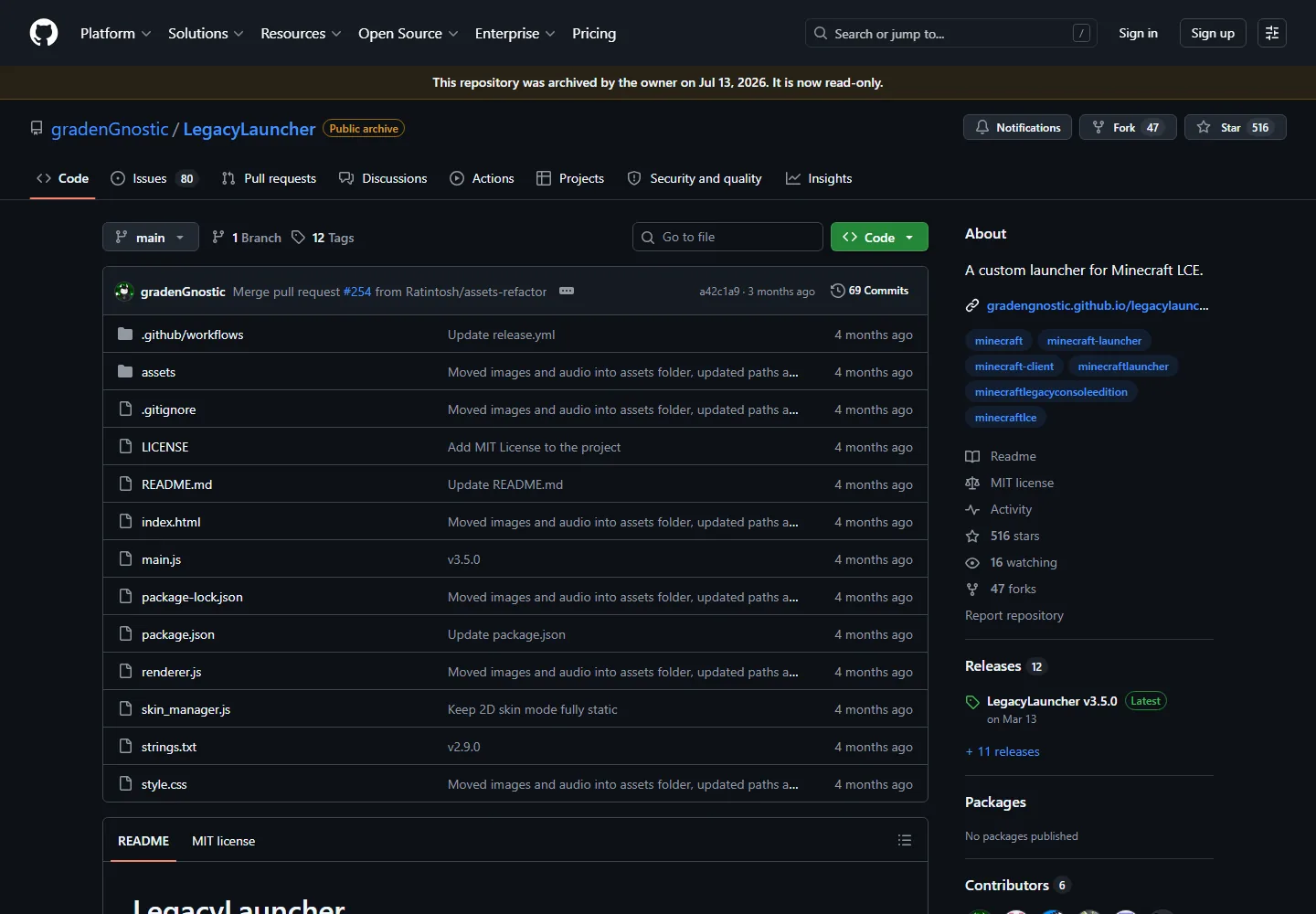
Confirm the owner and repository name: gradenGnostic/LegacyLauncher.
Match the release tag, date, notes, and platform package to your device.
Treat the archive banner as a maintenance boundary.
Prefer the official GitHub release page when a stable direct file URL cannot be verified.
Keep Minecraft game files, accounts, and unrelated launchers outside this release history.
older installations
Can an older installation be updated?
There is no verified universal in-app update workflow documented for this archived project, so do not assume that an old copy can update itself. The safer decision is to identify the installed version, close the launcher, back up screenshots and configuration that you need, and then compare the official release notes before replacing or reinstalling the platform package. Keep a copy of the old installer when you need a reversible troubleshooting path.
An update is also an opportunity to check product identity. If your old shortcut opens a Java launcher, TL Legacy, Legacy4J, or another application, installing a LegacyLauncher package will not turn it into the same product. Check the application name, repository owner, file extension, and installation location together. The Legacy Launcher name is not a license to merge unrelated version histories.
archive status
What does the archived status mean for future updates?
For users who need an actively maintained alternative, compare the product requirements first. Legacy4J is a separate Java Edition project, TL Legacy is a separate launcher path, and the official Minecraft Launcher is a different product again. The right choice depends on your game edition, account flow, platform, and controller needs; the update history alone cannot make that decision for you.
The repository page is useful evidence for ownership, source context, release links, and the read-only archive boundary.
If the release page does not show the file you expected, check the tag and repository first. A missing asset can be a network, browser, permissions, or release-page issue; it is not proof that a random mirror is the correct replacement. Record the exact filename and platform before searching for help.
If an installer opens but the launcher behaves differently, compare the release notes with your platform. Screenshots, controller prompts, Steam Deck mode, Linux desktop entries, and application-data paths are all details that can vary by build or environment. Avoid copying a command from a Java launcher guide into an LCE installation without checking what product it targets.
If a supposed update asks for an account, paid-game bypass, or unknown executable, stop. This site does not host Minecraft game files, free accounts, cracked builds, or bypass tools. Return to the official release page, the download center, or the safety guide and verify the source boundary before continuing.
Wrong project: re-check the owner, repository, and Minecraft edition.
Wrong package: match EXE, DMG, or AppImage to the operating system and architecture guidance.
Unexpected behavior: read the v3.5.0 notes for screenshots, controller, Steam Deck, and Linux changes.
Untrusted source: leave mirrors, cracked builds, account offers, and game-file downloads out of the update workflow.
FAQ
Legacy Launcher Errors and Troubleshooting FAQ
How do I fix Legacy Launcher errors?
Identify the failure stage, confirm the gradenGnostic/LegacyLauncher v3.5.0 source, back up your profile, and test a clean platform-matched start before changing one setting at a time.
Why does Minecraft Legacy Launcher keep crashing?
A mod, damaged profile, wrong package, unsupported instruction, or platform permission can cause a crash. Reproduce it without optional changes and compare the official release notes.
What should I do when Legacy Launcher will not open?
Check the repository owner, release tag, file type, operating-system architecture, and security or execute permission prompt. Do not replace the file with an unknown mirror.
Can I use TL Legacy troubleshooting steps?
No. TL Legacy, LegacyLauncher, Legacy4J, and the official Minecraft Launcher are separate products. Match the fix to the application that produced the error.